Dry-Growing on the Limestone Escarpment
Updated: 4 days ago
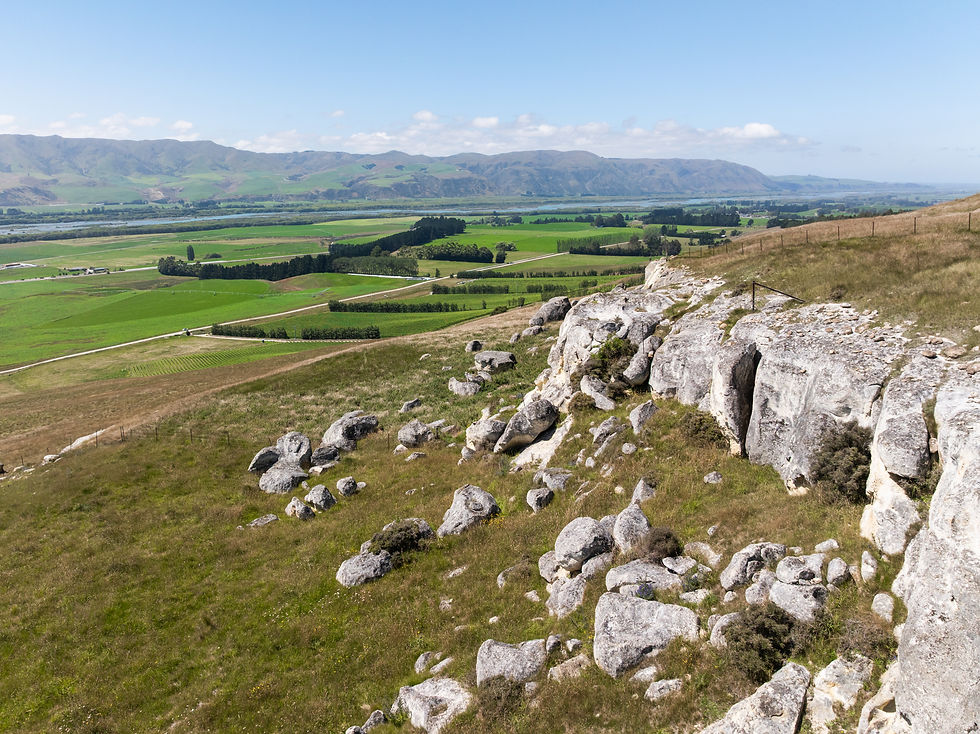
Exposed limestone and the vineyard landscape at Clos Ostler in the Waitaki Valley.
At Clos Ostler, the vines depend on rain and the water held beneath them. We dry-grow this north-facing limestone escarpment near Duntroon, so the timing of rain stays closely bound to the progress of the year. What falls during one part of the season may sustain the vines well into the next.
The pale limestone is the most visible part of that relationship. Beneath the rows, soil depth, texture and the spaces through which roots can grow help determine how the vineyard lives through summer. To understand dry-growing, we have to look below the familiar view of the slope.
Drainage and reserves
Water can drain freely through a soil while some remains held within it. These two functions are both important to vines. Soil depth, texture and structure influence how much ground roots can explore and how water moves or is retained. Pores within the soil differ in size; the arrangement of those spaces affects both drainage and water supply.
The Australian Wine Research Institute’s work on soil health draws attention to the whole soil profile. A dense layer beneath an apparently favourable surface can restrict roots; deeper, accessible ground may offer a different reserve. Water availability depends on this physical setting as well as the rock from which a soil formed.
Beneath the rows
The soil analyses from the estate show a strongly calcium-dominated environment. The Ostler Block sample records pH 6.9 and calcium saturation of 89 per cent; the Kairos sample records pH 6.7 and calcium saturation of 83 per cent.
These percentages measure calcium’s share of the soil’s nutrient-exchange capacity. Water storage is a separate question, governed by the depth, texture and structure of the ground. Together, those chemical and physical properties describe the conditions in which the roots grow.
The turn of the 2022 season
In 2022, a warm spring gave way to cool, damp conditions at flowering, reducing crop weight and berry size. Summer remained mild. Then came a dry, settled autumn, allowing ripening to continue until the Pinot Noir harvest, between 26 April and 5 May.
Calling that year simply wet or dry would lose much of its character. The damp flowering period and the settled autumn mattered at different moments. By May, the fruit had passed through both, and the eventual wine belonged to the whole sequence.
A season carried into the cellar
Caroline’s brings all five Pinot Noir clones together, reflecting the season across the planting. Its back vintages let us return to those years through their changing fruit, perfume and texture, long after the weather itself has passed.
We cannot trace a particular aroma to one rainfall event. What we can do is keep tasting, following the darker fruit of one year, the lifted fragrance of another and the savoury character that remains familiar. Over time, those bottles deepen our acquaintance with the slope.


Comments