Quiet Magic of the Waitaki Valley
Updated: Oct 18

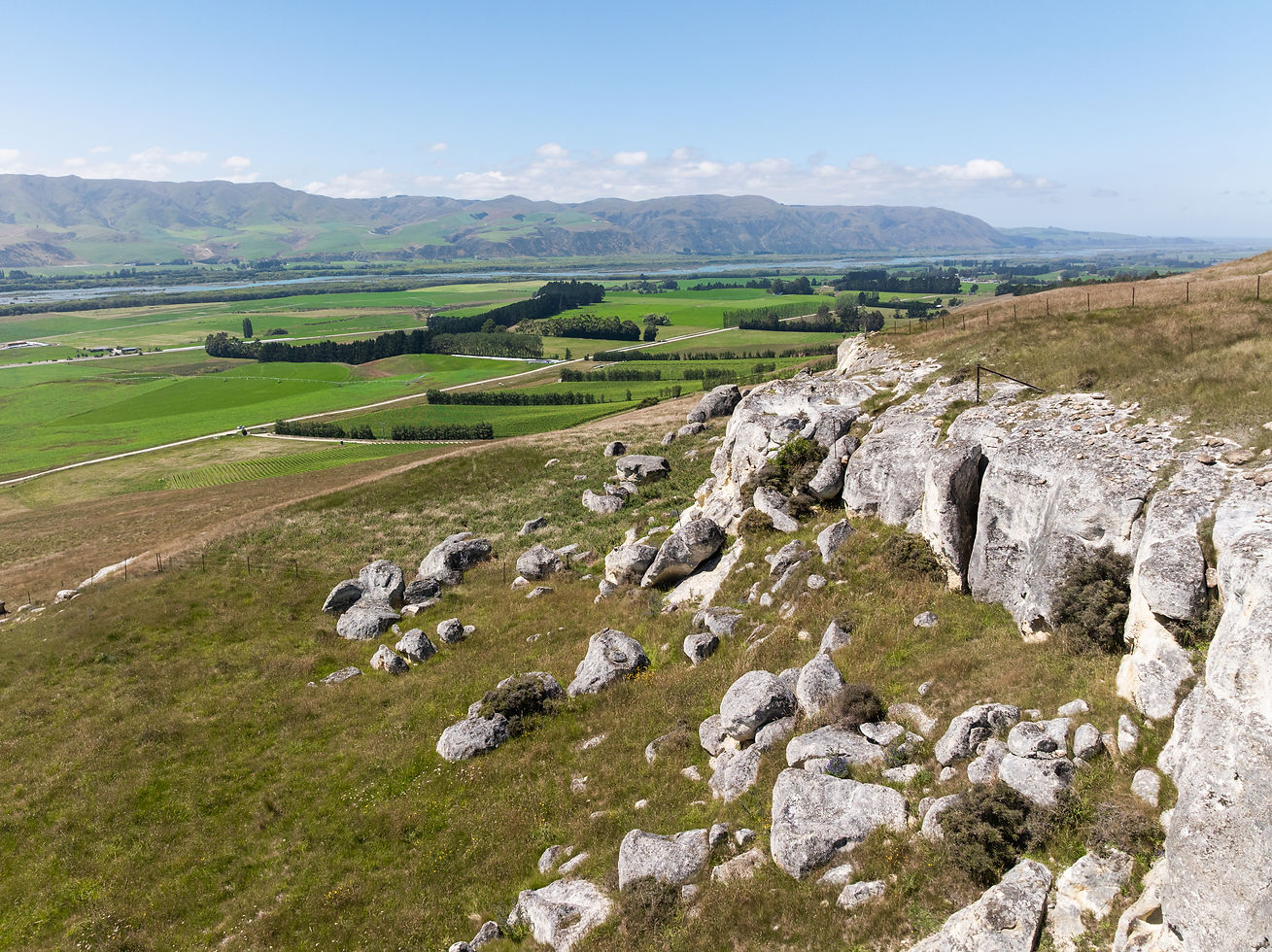
The more time I spend at Clos Ostler, the more extraordinary I find the relationship between this small vineyard and the landscape around it. Scallop shells remain embedded in the limestone wall beside the vines. Beyond the slope, the Waitaki carries glacial waters from the country’s highest mountain towards the Pacific. An ancient sea and a living river are both part of the place we call home.
Our family’s vineyard occupies eight hectares on a north-facing limestone escarpment near Duntroon in North Otago. The scale is intimate enough for the individual rows to become familiar. The view beyond them belongs to a much larger world of mountains, lakes and braided water. I find that contrast deeply moving.
A valley shaped by mountains and sea
The Waitaki’s catchment reaches into the Southern Alps, drawing water from Aoraki, New Zealand’s highest mountain, through Lake Pūkaki and the wider river system. In Ngāi Tahu tradition, the Waitaki is known as Kā Roimata o Aoraki, the Tears of Aoraki. It is a beautiful way of understanding the connection between the mountain and the water travelling through this valley.
Benmore and Aviemore are part of the landscape upstream. Farther along the journey, Kurow, Duntroon and Ōamaru give the valley different expressions of its history. The Alps 2 Ocean Cycle Trail brings many people into contact with these places, following the changing country towards the coast.
Around Duntroon, marine fossils and Māori rock art add further depth to that experience. The limestone preserves traces of a world in which the present hills lay beneath the sea. At Clos Ostler, that history is close enough to touch.
The shells in the wall
The wall around the vineyard was built as the vines were planted, using limestone boulders containing recognisable scallops and smaller shell fragments. Looking closely at their ribbed forms makes the marine origins of the ground wonderfully tangible. These details are among the things I most enjoy showing someone encountering the estate for the first time.
The wall gives physical form to the clos. Within it, Pinot Noir, Chardonnay and Pinot Gris grow as parts of one family-owned monopole vineyard. Every Clos Ostler wine begins here, allowing us to follow the same ground through different varieties, selections and seasons.
Jim Jerram and Jeff Sinnott recognised the promise of this hillside when modern winegrowing in the Waitaki was still taking shape. Pinot Noir was planted in 2002. Their decision to commit to a demanding, unfamiliar region gave us the foundation we continue to build upon.
Our family brings a Swiss winemaking heritage to the next chapter of Clos Ostler. Knowledge of limestone soils and the way cool-climate varieties respond to them is part of that inheritance. It gives us a particular connection with this North Otago hillside and a strong belief in the quality it can produce.
For me, continuing the legacy established here means bringing that family experience into the ongoing work of understanding the vineyard. We do so alongside the estate’s viticultural and winemaking team, following the individual parcels, the seasons and the wines as they mature. The knowledge we inherit becomes most valuable through the attention we give this place.

A small slope with unusual advantages
The Waitaki is a cool place to grow wine, and the position of a vineyard matters enormously. Our north-facing aspect receives sunlight within that cool setting. The hillside allows cold air to move towards lower ground when conditions favour drainage, while air movement helps the foliage dry.
Westerly winds arriving from the direction of the Southern Alps and easterly influences from the Pacific are part of the vineyard’s life. We follow their effects through the season, alongside the changing weather and the progress of the fruit. A favourable slope gives us valuable advantages within a region that asks a great deal of its growers.
The vines are dry-grown, relying on rainfall and water held in the ground. Soil depth, structure and the fractured limestone beneath the rows all belong to that relationship. The long season gives us time to follow flavour and skin development, with freshness remaining central to the wines we want to make.
Small scale makes the work personal. There are few economies of scale on an isolated North Otago hillside. The attention given to the vines, and the patience required in the cellar, are part of what each bottle represents.
The vineyard in the glass
Caroline’s Pinot Noir brings together five clones, 115, 667, 777, UCD6 and Abel, as a complete expression of the season across the vineyard. The components are harvested and fermented separately, then followed through maturation before blending. That separation gives us time to understand their individual contributions.
EOS is a more focused selection centred on 667 and 777, with a smaller contribution from Abel. Perfume, power, silky texture and the ability to develop with age guide its composition. The distinction between Caroline’s and EOS comes from how the vineyard’s components are brought together.
The first three EOS vintages have already offered strikingly different experiences. The 2022 has crystalline elegance, dried raspberry, wild strawberry, crushed rose and lemon thyme. The 2023 is precise and lifted, with cherry compote, roses, rosehip, bramble, dried raspberry and fresh herbs, carried by an almost lime-like freshness.
The 2024 is darker and considerably more complex in our early tastings. Dried plum, fig and cherry sit alongside herbal and savoury details, with silky tannins preserving its finesse. It is a wine that has strengthened my conviction in what this vineyard can achieve.
Chardonnay adds another voice. The 2025 combines pear and floral character with brioche and a saline impression, its partial malolactic fermentation retaining a particularly fresh outline. Audrey’s Pinot Gris brings its own fresh, savoury-leaning character. Together, the wines make the vineyard feel more expansive than its size suggests.
What time reveals
Some of the most persuasive encounters happen with older Caroline’s. In bottles of the 2010, we have found black-truffle aromas with perfume and freshness still present. The wine has acquired detail that could only be encountered by keeping it and returning to it.
That history gives substance to our confidence in ageworthy Waitaki Pinot Noir. Caroline’s provides a record reaching back to the early years of the vineyard. EOS begins its own longer journey with the concentration, freshness and fine tannins that make us excited to follow it.
International recognition has brought more people into this story. Caroline’s 2021 received 96 points and the New Zealand Red, New Zealand Pinot Noir and North Otago Pinot Noir trophies at the 2025 International Wine Challenge. EOS 2022 received Platinum and 97 points at the 2026 Decanter World Wine Awards.
I am proud of those achievements. They give a wider audience reason to discover a small vineyard in North Otago, and to consider its wines alongside fine wines from much more established regions.
Time above the vines
Staying at Clos Ostler offers another way to understand the wines. From the vineyard suites, the rows become part of the view through the day, while the valley opens beyond them. Time spent among the limestone, at Duntroon’s fossil sites or travelling through the lakes gives the name Waitaki a lasting physical meaning.
I hope one day to welcome you to this valley that drains the glacial waters from New Zealand’s tallest mountain. We can open a bottle, look across the vines and let the place tell more of its story.
Connor Roulet Magides, Owner and Custodian, Clos Ostler


Comments